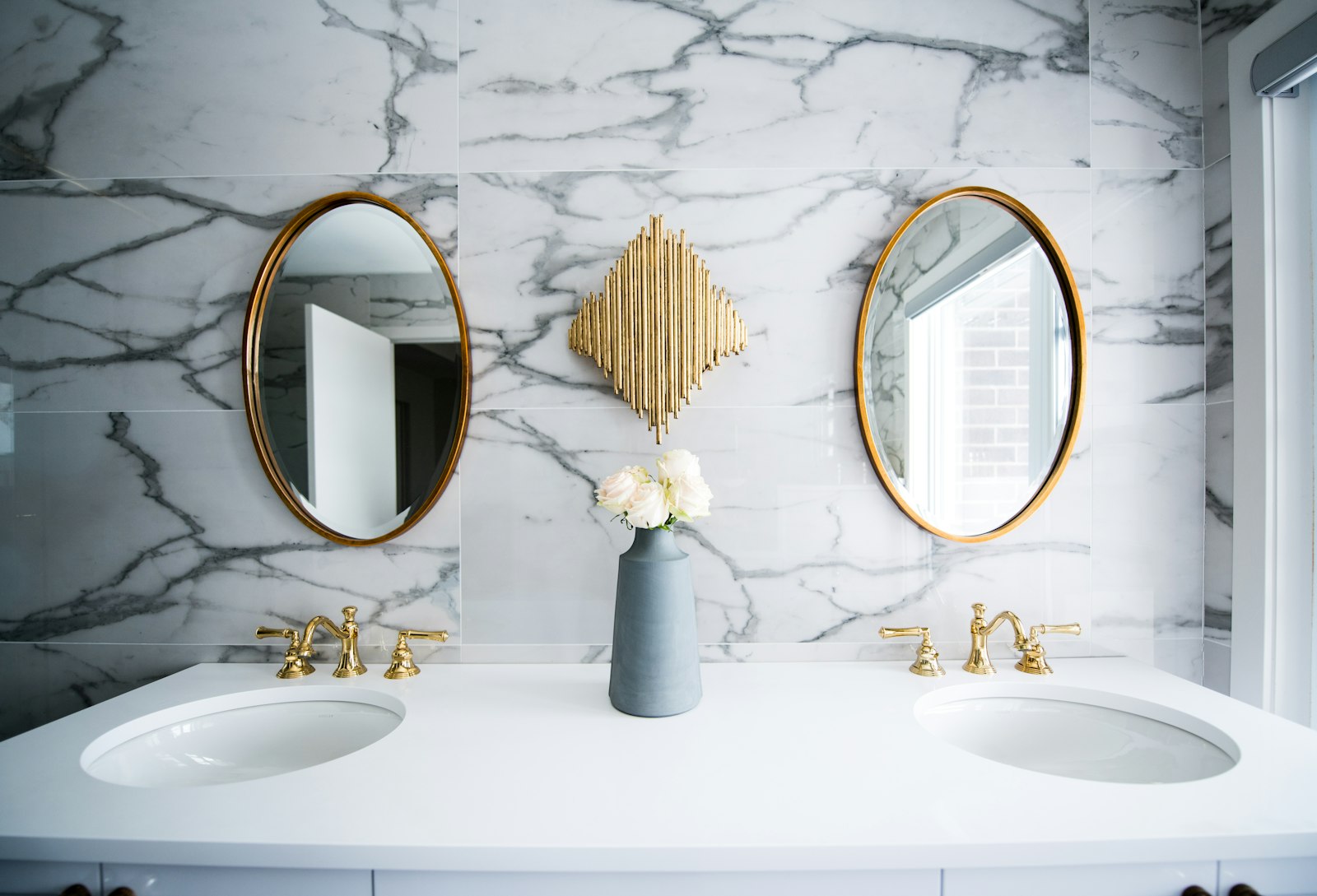
In Belgium in 2026, tile installation costs on average <strong>€35 to €55 per m² excl. VAT</strong> for labour only (€50 to €90/m² for large formats), and the tiles themselves €20 to €110/m² depending on the material. For a home over 10 years old, VAT drops to <strong>6%</strong> if the same contractor supplies and lays the tiles. Here are the detailed prices, the 2026 trends and the pitfalls to avoid before you order.
Quick answer: tiling cost per m² in Belgium (2026)
Indicative prices excl. VAT, cross-checked against price surveys published in Belgium in 2026 (TrustUp, Tafsquare, KlusConnect, Bobex) and rounded. The exact price depends on a site visit.
- Installation only, standard tile: €35 to €55/m² on average (observed range €25 to €65/m² depending on substrate, layout and region).
- Installing large formats (from 60x60 cm, XXL): €50 to €90/m².
- Tiles themselves: €20 to €45/m² for standard porcelain stoneware, €40 to €85/m² for XXL, €50 to €110/m² for natural stone.
- Tiler hourly rate: roughly €30 to €60/h excl. VAT.
- Reduced 6% VAT for a private home over 10 years old, if the same contractor supplies and installs: up to €918 saved on 60 m² compared with 21%.
Tile installation price per m² by tile type
A tiling project has two main cost items: the tiles and the installation labour (adhesive, grout and spacers included). Average prices excl. VAT per m²:
| Tile type | Tiles | Installation | Estimated total |
|---|---|---|---|
| Standard porcelain stoneware (45x45 / 60x60) | €20–45 | €35–55 | €55–100 |
| XXL / rectified porcelain stoneware (80x80, 120x60) | €40–85 | €50–90 | €90–175 |
| Wood-effect planks (20x120) | €35–70 | €45–70 | €80–140 |
| Natural stone (travertine, marble) | €50–110 | €55–80 | €105–190 |
| Wall tiles (bathroom) | €25–65 | €45–80 | €70–145 |
| Zellige / artisan mosaic | €60–130 | €60–100 | €120–230 |
- Format: large slabs need a flatter substrate, double-buttering and often two tilers.
- Layout: diagonal, herringbone or running bond takes more time and creates more offcuts than a straight layout.
- Substrate: a new screed or levelling is charged on top of the installation.
- Finishing: skirting, trims, silicone and shower waterproofing add hours of work.
Extra costs: removal, screed, levelling, waterproofing
Depending on the condition of the substrate, add (indicative prices excl. VAT):
- Removing old tiles + disposal: €15 to €30/m²
- Traditional or liquid screed: €20 to €35/m²
- Levelling the substrate: €10 to €25/m²
- Anti-crack decoupling membrane (Ditra type): about €25 to €35/m², recommended on fresh screed or with underfloor heating
- Waterproofing under tiles (SPEC) for showers: about €35 to €45/m²
- Special grout (epoxy, waterproof): about €10 to €20/m² extra
- Matching skirting tiles: €10 to €50 per linear metre depending on the material
6% VAT on tiling work: the conditions
For the renovation of a dwelling, VAT is 6% instead of 21% if the following conditions are met. Always check the current rules on the FPS Finance website or with your contractor.
- The property is a private dwelling more than 10 years old (counted from its first occupation).
- The dwelling is used mainly for private purposes.
- The work and the materials are supplied and invoiced by the same registered contractor, under a single contract.
Worked example: 60 m² living room and kitchen
Tiles: 60 m² × €45 = €2,700. Professional installation: 60 m² × €45 = €2,700. Levelling the substrate: €720. Subtotal: €6,120 excl. VAT.
| Scenario | VAT rate | VAT amount | Total incl. VAT |
|---|---|---|---|
| Ineligible dwelling (under 10 years old, new build): everything at 21 % | 21 % | €1,285 | €7,405 |
| Tiles bought separately (21 %) + installation by a contractor (6 %) | 21 % / 6 % | €772 | €6,892 |
| Supply + installation by a single registered contractor (eligible dwelling) | 6 % | €367 | €6,487 |
Wood-effect tiles: price, herringbone layout and underfloor heating
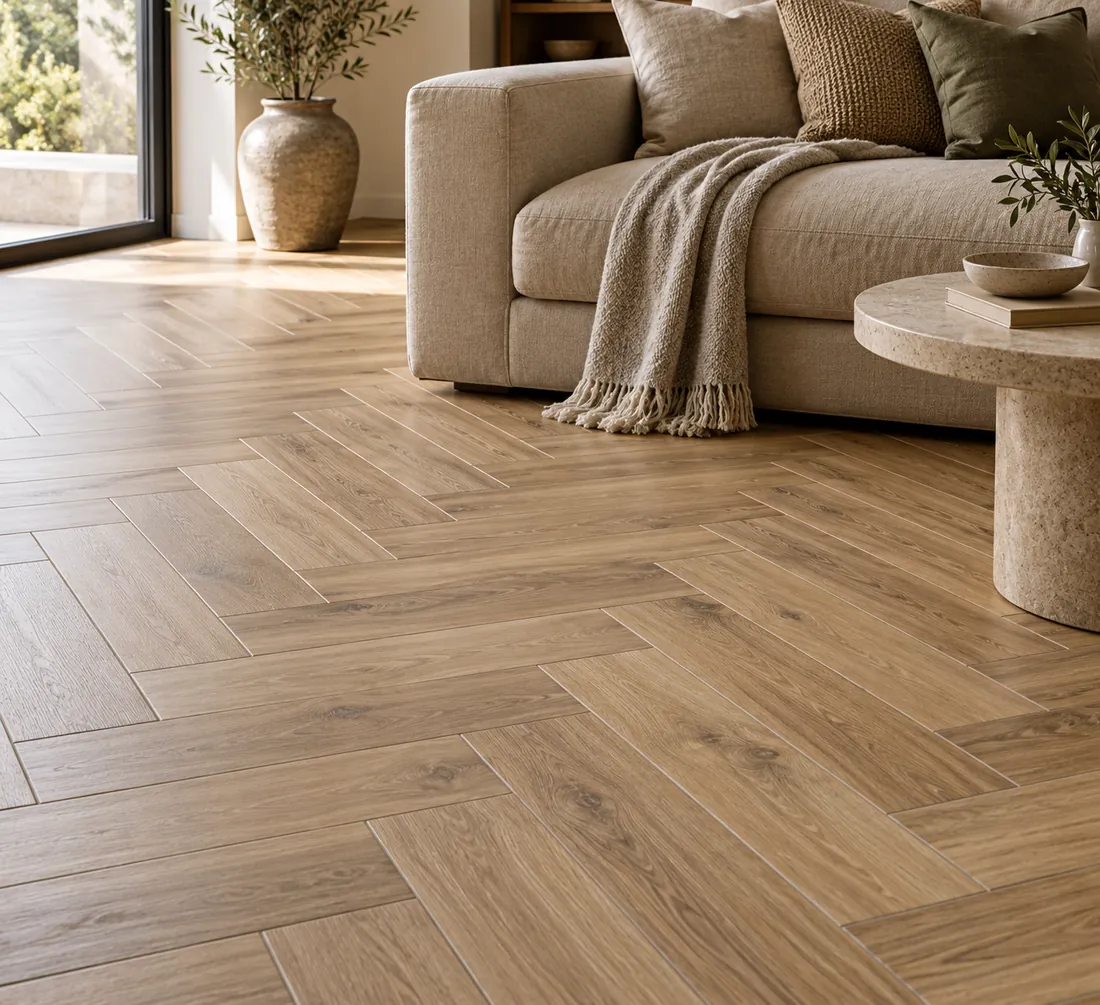
Wood-effect porcelain tiles (for example 20x120 cm planks) give the visual warmth of oak with no oiling or varnishing. Budget €35 to €70/m² for the tiles and €45 to €70/m² for installation. Trending layouts: running bond (joints offset by a third) or herringbone, which take longer and so cost more.
With underfloor heating, porcelain stoneware is the best choice: it is dense, conducts heat well and does not warp. Use a flexible adhesive (class C2 S1 or S2), lay on a dry screed and follow the gradual heat-up recommended by the manufacturer.
Large-format (XXL) tiles: benefits, installation price and precautions
60x60 cm remains a safe choice, but 80x80, 100x100 and 120x60 cm formats are gaining ground: fewer grout lines, so living rooms, open kitchens and halls look bigger. With rectified edges, joints can be as thin as 1.5 to 2 mm.
The trade-off: more expensive installation (€50 to €90/m²), a perfectly flat substrate (levelling is often needed), systematic double-buttering and two-person handling.
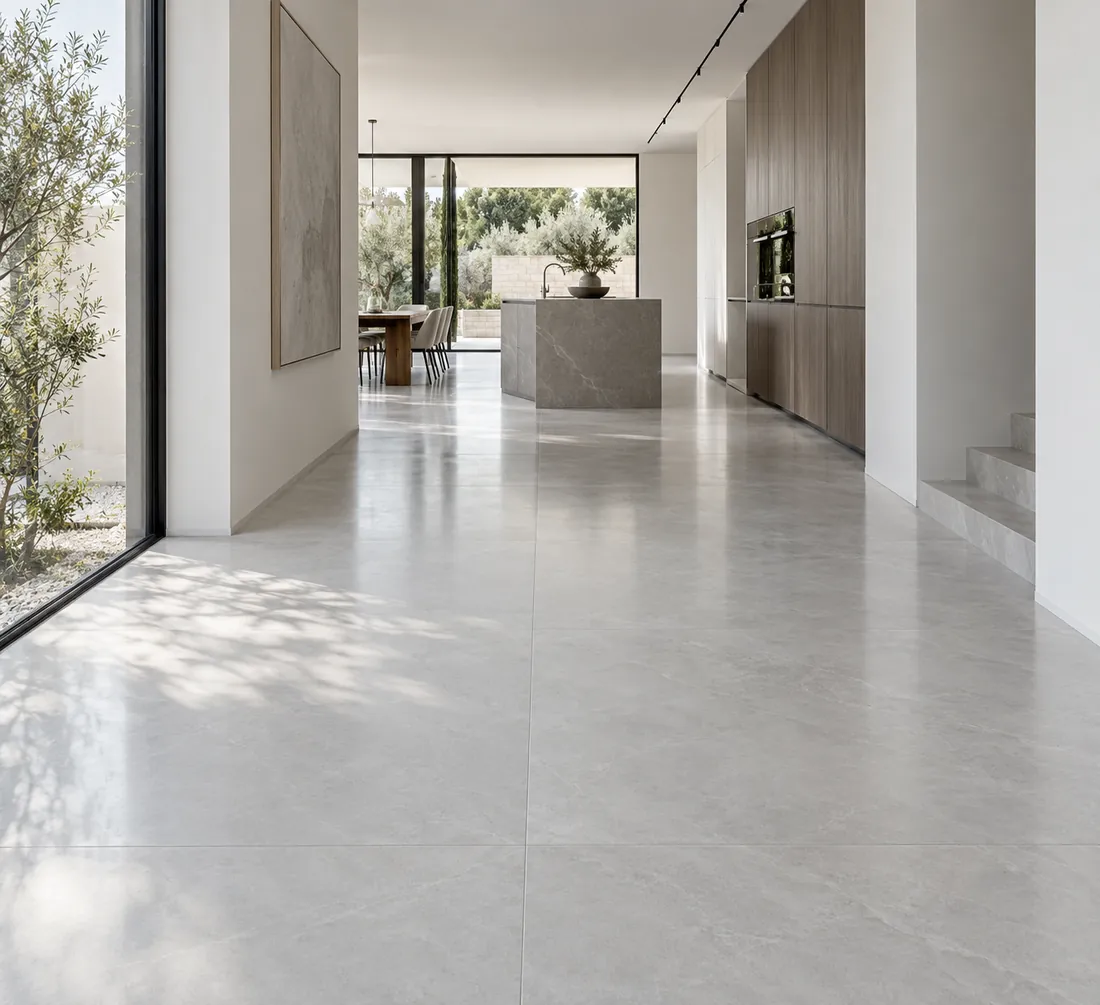
- Benefits: sense of space, few joints, easy maintenance.
- Watch out for: substrate flatness, breakage risk when handling, more offcuts.
Travertine-effect tiles and bathrooms: mood, waterproofing, slip resistance
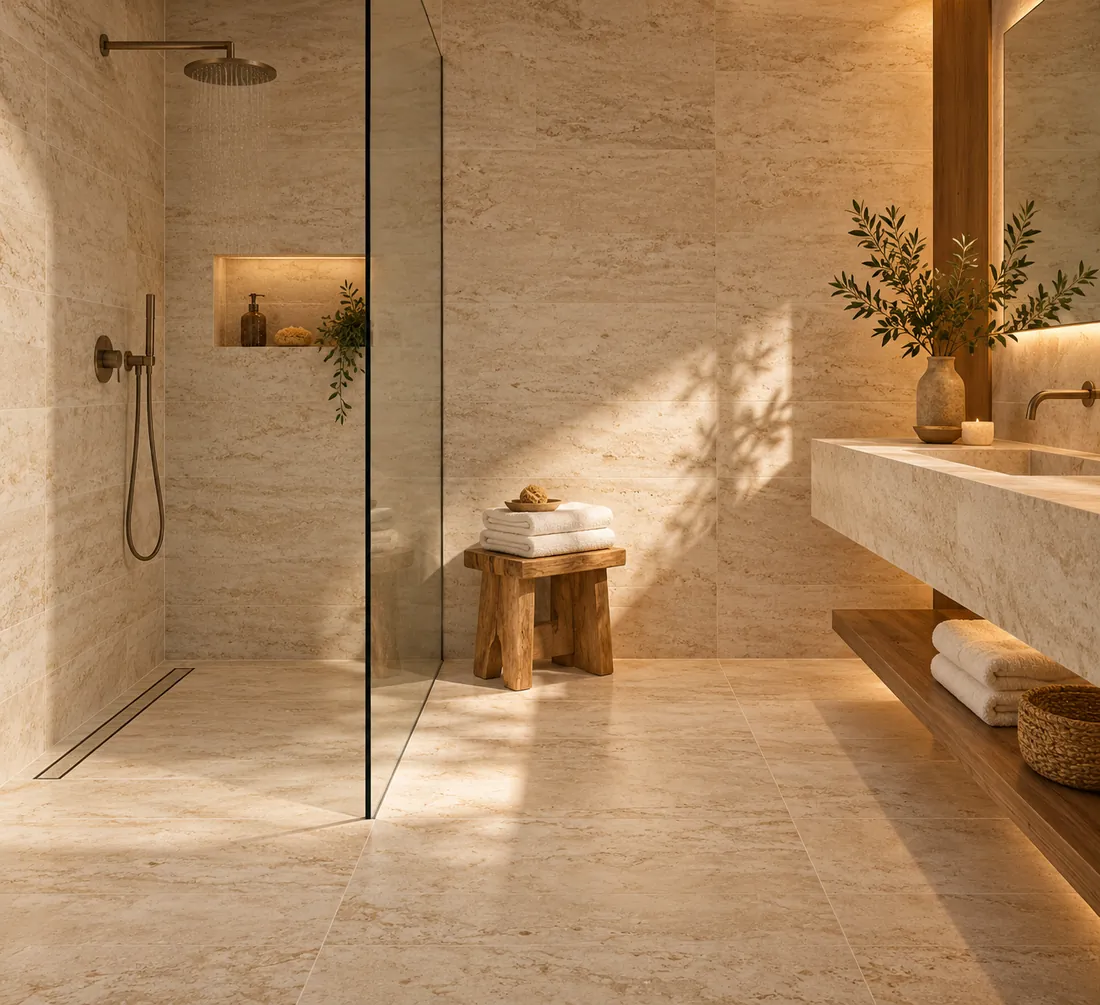
Travertine (beige or grey) and its porcelain imitations dominate zen bathrooms and continuous indoor/outdoor floors. Natural stone costs €50 to €110/m² (installation €55 to €80/m²) and needs regular upkeep; travertine-effect porcelain is cheaper and easier to live with.
For a walk-in shower, plan for waterproofing under the tiles (SPEC), a suitable drain (see our shower and bath products) and a non-slip R10 or R11 tile.
Zellige tiles: kitchen splashback and shower walls
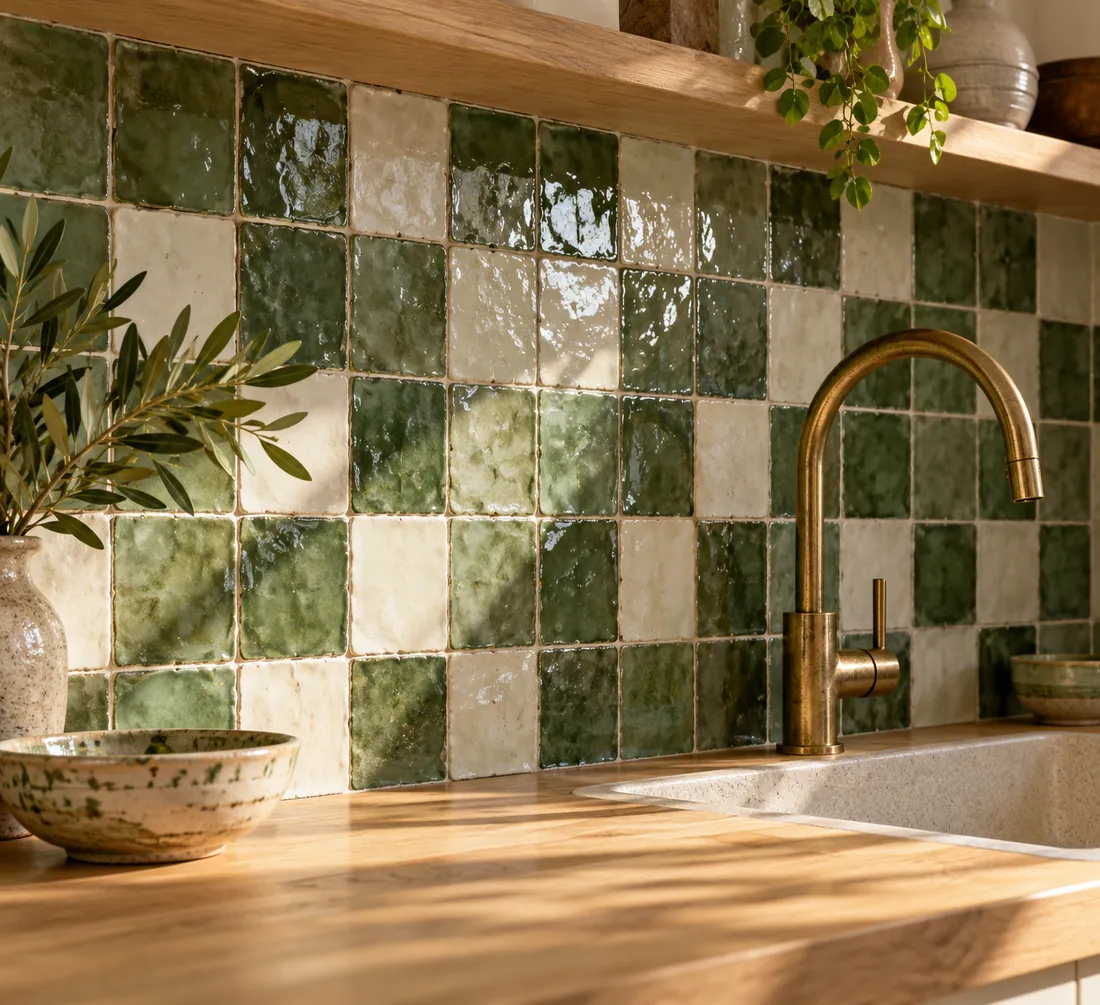
A Moroccan-style zellige tile adds relief, subtle shade variations and irregular edges that catch the light: ideal for a kitchen splashback or a shower niche. Budget: €60 to €130/m² for the tiles and €60 to €100/m² for installation, as each tile is set by hand.
Choose fine, matching grout lines and test how the grout cleans before you commit (crazed glazes stain easily).
Outdoor tiles and terraces: 20 mm, on pedestals, non-slip
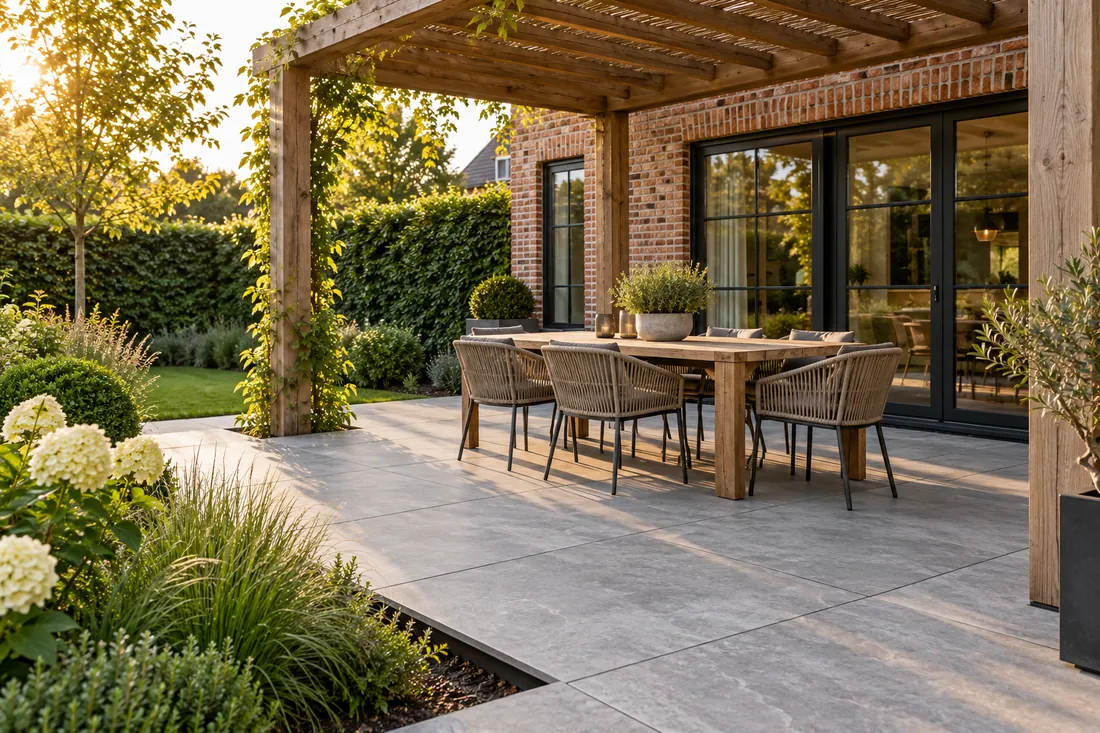
For a terrace in Belgium, the tile must be frost-resistant (water absorption below 0.5%), non-slip (R11 recommended) and ideally 20 mm thick for installation on pedestals, which drain water and absorb level differences.
For bonded installation, choose a draining base, an outdoor adhesive and allow a fall of 1 to 2% to shed rainwater.
Choosing your tiles: PEI, slip resistance R9 to R13, rectified edges
Don't rely on looks alone. Check these three indicators on the technical data sheet:
- Abrasion resistance (PEI): PEI III for bedrooms and bathrooms, PEI IV for living rooms, kitchens and hallways, PEI V for shops, direct entrances and heavy traffic.
- Slip resistance: R9 for living areas and bedrooms; R10 / R11 for bathrooms, wet rooms, pool surrounds and terraces.
- Rectified edges: perfectly straight edges, allowing fine 1.5 to 2 mm joints for a seamless look.
Who should lay them?
A successful job rests on two requirements: the quality of the tiles and the precision of the installation.
Alpha Services Benelux carries out installation to good practice and Buildwise (formerly BBRI/CSTC) recommendations: substrate preparation (levelling, screed, decoupling), cuts for XXL slabs and walk-in showers.
To get 6% VAT on the tiles, ask from the start for an all-in supply + installation quote from the company carrying out the work: request a quote.
Frequently asked questions
How much does tile installation cost per m² in Belgium in 2026?
In 2026, tile installation costs on average €35 to €55 per m² excl. VAT for labour only on a standard tile, and €50 to €90/m² for large formats. The observed range is €25 to €65/m² depending on substrate, layout and region. Add the tiles (€20 to €110/m²) and substrate preparation.
What is the price of tiles per m² (tiles only)?
Budget €20 to €45/m² for standard porcelain stoneware, €40 to €85/m² for XXL large format, €35 to €70/m² for wood-effect, €50 to €110/m² for natural stone and €60 to €130/m² for artisan zellige (indicative prices excl. VAT).
What VAT applies to tiling work: 6% or 21%?
6% for the renovation of a private home over 10 years old, provided the contractor supplies and invoices both the labour and the tiles under one contract; 21% for a more recent home or for tiles bought separately. Check the current rules with the FPS Finance.
Which tiles are best for underfloor heating?
Porcelain stoneware is the ideal material: its high density gives good conductivity and thermal inertia, including for wood-effect planks 10 to 12 mm thick. Lay it with a flexible adhesive (C2 S1 or S2) on a dry screed and follow a gradual heat-up.
Are large-format tiles more expensive to install?
Yes, installation generally costs €50 to €90/m² against €35 to €55/m² for a standard tile: large formats need a perfectly flat substrate, double-buttering and often two tilers.
Which tiles should I choose for a terrace or outdoors?
They must be frost-resistant (water absorption below 0.5%), non-slip (R11 recommended) and ideally 20 mm thick for installation on pedestals or bonded drainage-bed installation, to withstand freeze-thaw cycles in Belgium.
How long does it take to tile 50 m²?
Allow 4 to 7 working days, floor preparation included: day 1, substrate preparation; days 2 to 4, adhesive and laying with self-levelling spacers; day 5, adhesive drying (24 to 48 h); day 6, grouting and site clean-up.
Why choose double-buttering?
Double-buttering means applying adhesive to both the floor and the back of the tile. It is essential for tiles larger than 60x60 cm: it prevents air pockets under the tile and so breakage on impact.
How many extra tiles should I order for offcuts?
Order 10% extra, up to 15% for diagonal or herringbone layouts, and keep a spare box for future repairs.
How do I get a supply + installation quote with 6% VAT?
Ask the company that will carry out the work for an all-in supply + installation quote. 6% VAT applies to the tiles only if that company supplies and invoices them, under one contract, for a home over 10 years old. State this in your quote request.