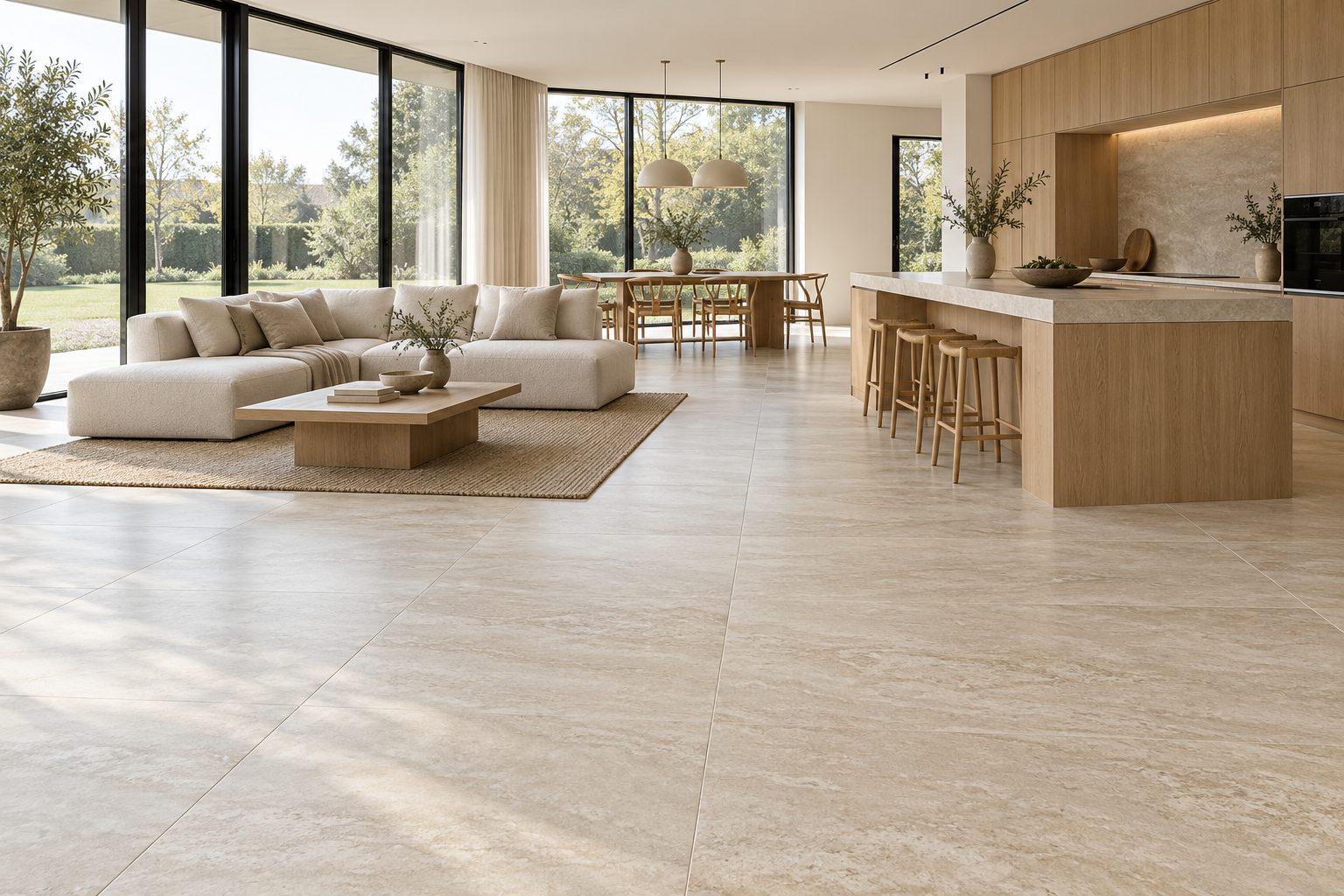
To choose a floor tile, check four things: the <strong>tile type</strong> (porcelain stoneware absorbs less than 0.5 % water), the <strong>abrasion resistance</strong> (PEI class for glazed tiles), the <strong>slip resistance</strong> (R9 to R11 for shod feet, A/B/C for bare feet) and, outdoors, <strong>frost resistance</strong>. This guide explains how to read these values on the data sheet, room by room.
Quick answer: which tile for which room
- Bedroom, home office: glazed porcelain stoneware PEI 2 to 3, slip resistance R9.
- Living room, hallway, kitchen: PEI 3 to 4, R9 or R10 if the floor can get wet.
- Bathroom: R10, and at least class B (DIN 51097) in the shower area.
- Covered terrace: R10; open terrace, pool surround: R11, with a frost-resistant tile.
- Always ask for the tile's data sheet: the classes must be listed there, not only on the packaging.
Porcelain stoneware: what the standard says
Ceramic tiles sold in Belgium fall under the harmonised European standard NBN EN 14411 (equivalent to ISO 13006), which makes CE marking mandatory. It sorts tiles by manufacturing method and water absorption. Porcelain stoneware belongs to the densest group, with absorption of at most 0.5 %.
That low porosity explains its frost and stain resistance. It says nothing about glaze thickness or slipperiness: check those separately (see below). Glazed tiles resist stains better than unglazed ones; polished tiles are stain-sensitive and better kept indoors (source: Buildwise).
| Group | Water absorption (E) | Common use |
|---|---|---|
| BIa | E ≤ 0.5 % | Porcelain stoneware, floors indoors and outdoors |
| BIb | 0.5 % < E ≤ 3 % | Fine stoneware, indoor floors |
| BIIa | 3 % < E ≤ 6 % | Indoor floors and walls |
| BIIb | 6 % < E ≤ 10 % | Walls, lightly used floors |
| BIII | E > 10 % | Wall tiles |
The PEI class: measuring glaze wear
The PEI class (0 to 5) states the surface abrasion resistance of a glazed tile. It is an American scale (Porcelain Enamel Institute); in Europe the matching test is described in ISO 10545-7 and the classification appears in an informative annex of ISO 13006. A through-body or unglazed tile needs no PEI class.
The manufacturer sets the class; the table below shows common uses. The higher the class, the better the glaze withstands shoes carrying sand or grit, which scratch dark and glossy surfaces first (see the Buildwise article on wear of hard floors).
| PEI class | Traffic | Rooms |
|---|---|---|
| PEI 1 | Very light, bare feet or slippers | Private bathroom with no direct outdoor access |
| PEI 2 | Light | Bedrooms, home office |
| PEI 3 | Medium | Living room, hallways, home kitchen |
| PEI 4 | Heavy | Entrance, open kitchen, busy hallway |
| PEI 5 | Very heavy | Commercial or public spaces, also useful at a home entrance |
Slip resistance: R9 to R13 and A, B, C
Slipperiness is measured on a tilting ramp. DIN 51130 tests shod feet and gives a class from R9 to R13 depending on the angle before slipping. DIN 51097 tests bare feet on a wet floor and gives classes A, B or C. A tile can carry both, for example “R10 / B”.
The higher the grip, the more textured the surface and the more careful the cleaning. R11 is unnecessary in a living room. These classes are indicative: check them on the manufacturer's data sheet. Wall tiles need no slip class.
For a walk-in shower, the drain grate matters as much as the tile: on alphanco.be see the shower drains, shower trays and walk-in showers, for example the ALONI 60 cm brushed stainless shower drain or the 50 cm stainless tile-insert grate.
| Class | Slip angle | Typical use |
|---|---|---|
| R9 | 6° to 10° | Dry living room, bedroom, hallway |
| R10 | 10° to 19° | Kitchen, bathroom, entrance, covered terrace |
| R11 | 19° to 27° | Open terrace, pool surround, often-wet floor |
| R12 / R13 | 27° to over 35° | Professional or industrial use |
| A, B, C (bare feet) | A ≥ 12°, B ≥ 18°, C ≥ 24° | A: dry changing rooms; B: showers and pool edges; C: submerged steps, wet slopes |
Indoors and outdoors: frost, thickness, continuity
Outdoors, the tile must stay intact after the frost test (Buildwise stresses this). Group BIa porcelain stoneware usually passes, but check that the manufacturer states it for the chosen model. Avoid polished tiles outside.
To extend the living room onto the terrace, many ranges come in two versions: 9 to 10 mm indoors, 20 mm anti-slip outdoors, laid on pedestals, gravel or grass. Keep different classes though: R9 or R10 inside, R11 outside if the terrace is exposed to rain.
For budgeting, read our guide to tile laying prices in Belgium.
Format, adhesive and laying
Above 30 x 30 cm, Buildwise states that double-buttering is required. A class C2 adhesive is recommended for low-porosity tiles (E < 3 %), very large formats, heavily used rooms and underfloor heating. XL and XXL tiles and wood-look planks need a very flat substrate.
Allow 10 % extra surface for cuts and offcuts, more for diagonal layouts. For laying, the quote request lets you describe your project, and professionals can use the pro area. The Dilbeek store also welcomes you on site for bathroom products.
Maintenance and precautions
Lukewarm water with a mild detergent is enough for glazed porcelain stoneware. Avoid undiluted strong acids on cement grout. For polished or unglazed tiles, follow the manufacturer's instructions: some call for a stain-protection treatment.
Underfloor heating works with porcelain stoneware provided you use the adhesive and grout intended for it (Buildwise cites deformable C2 class S1 or S2 for heated floors) and follow the gradual warm-up given by the installer.
Sources
- Buildwise: ceramic tiles, tile adhesives and grouts (NBN EN 14411, frost, slip resistance, C2 adhesive; in French)
- Buildwise: wear of hard floor coverings (article 2004/03.05, in French)
- Buildwise: NIT 237, laying floor coverings in ceramic tiles (in French)
- ISO 13006:2018: ceramic tiles, classification (preview)
- Italgres: slip resistance, DIN 51130 and DIN 51097 classes
Frequently asked questions
Which PEI class for a living-room tile?
PEI 3 for a standard living room, PEI 4 for heavy traffic (entrance, direct access from outside). The PEI class only applies to glazed tiles.
R9 or R10 for a bathroom?
R10 is the usual choice for a bathroom, and the shower area needs at least class B (DIN 51097), barefoot on a wet floor. Rely on the manufacturer's data sheet.
What anti-slip rating for an outdoor terrace?
R10 under cover, R11 if the terrace is exposed to rain or sloped, with a frost-resistant tile. Avoid polished tiles.
What is a rectified tile?
Its edges are cut after firing for very regular dimensions. Joints can then be thin, but the substrate must be very flat.
Is a water-repellent treatment always needed on porcelain stoneware?
Not for ordinary glazed porcelain stoneware. For a polished or unglazed tile, follow the manufacturer's instructions: some recommend stain protection.